

Preparing for Burning Man means making hundreds of decisions before you ever set foot in Black Rock City. You will think about tickets, costumes, transportation, shelter, lighting, bicycles, water, and countless other details. Somewhere along the way, almost everyone asks the same question. “What am I going to eat for an entire week in the desert?” That question deserves more attention than many people give it. A thoughtful Burning Man Food Planning Guide does much more than prevent hunger. It helps you save money, reduce stress, minimize food waste, protect valuable cooler space, and spend less time managing camp. Most importantly, it gives you more freedom to experience everything that makes Burning Man extraordinary.
This guide is designed for both first-time and experienced burners. Whether you are building your first camp kitchen or refining a system that has served you for years, the goal remains the same. Create a food plan that supports your adventure instead of becoming another challenge to manage.
While this Burning Man Food Planning Guide focuses on building an overall food strategy, our companion article, Burning Man Meal Planning Guide: Easy, Delicious Meals for the Playa, explores practical meal ideas, recipes, and menu planning. Together, these two guides will help you build a camp kitchen that is efficient, organized, and enjoyable. Before continuing, there is one important distinction to make.
A Quick Note About This Guide
This guide focuses on personal meal planning and shared meals within your own camp. If your camp plans to gift food to the public, Nevada health regulations establish additional food safety requirements for food handling, preparation, storage, sanitation, and temperature control. Work closely with your camp kitchen lead and review the current guidance from the Nevada Department of Health before planning any public food gifting.
The Burning Man Food Planning Guide Philosophy: Survive or Thrive?
Technically, surviving Burning Man is not especially difficult. Bring enough food, water and basic supplies. Do those things, and you will probably make it through the week just fine. Thriving is something entirely different.
Thriving means waking up excited for another day of adventure instead of wondering what you are going to cook. It means spending ten minutes preparing dinner instead of forty-five. It means saying “yes” when new friends invite you to explore deep playa because your meal is already waiting back at camp. That philosophy shapes every recommendation in this Burning Man Food Planning Guide.
The best food plan is rarely the most elaborate one. It is the plan that quietly does its job in the background while you focus on art, music, community, volunteering, and the countless unexpected moments that make Black Rock City unlike anywhere else in the world. Throughout this guide, you will notice a simple philosophy appearing again and again. Thoughtful preparation creates freedom.
Start With Your Food Strategy
Before writing a shopping list or buying a cooler, decide how you want to feed yourself during the event. Every camp approaches food a little differently. Most systems fall into one of three categories.
Group Meal Plans
Many larger theme camps operate shared commissary kitchens. Camp members contribute toward food costs while dedicated kitchen leads organize shopping, cooking, refrigeration, and cleanup. For many participants, this approach works extremely well. Bulk purchasing often reduces costs. Experienced cooks handle the logistics. Members have one less major planning task to worry about before leaving home. However, every shared system depends on shared infrastructure.

The 2023 “Mud Burn” reminded everyone of that reality. Heavy rain stopped vehicle movement throughout Black Rock City. Fuel deliveries also stopped. Some camps depended on generators to keep refrigerators and freezers operating. Once the generators ran out of fuel, refrigeration failed and food spoiled much sooner than expected. Participants who had packed personal backup food found themselves in a much more comfortable position than those who relied entirely on the camp kitchen.
That experience does not mean commissary kitchens are a bad idea. Many operate exceptionally well. Instead, it reinforces one of Burning Man’s oldest lessons. Prepare to take care of yourself, even when everything appears to be running perfectly.
Individual Food Planning
Some burners prefer complete control over their meals. Planning individually allows you to decide what to eat, when to eat, and how much effort you want to spend cooking. Flexibility becomes one of the greatest advantages. Perhaps you spend the night dancing until sunrise. Maybe a volunteer shift runs longer than expected. Friends might invite you to explore an art installation that was never on your schedule.
A personal food plan adapts just as easily as your adventure.
The Hybrid Approach
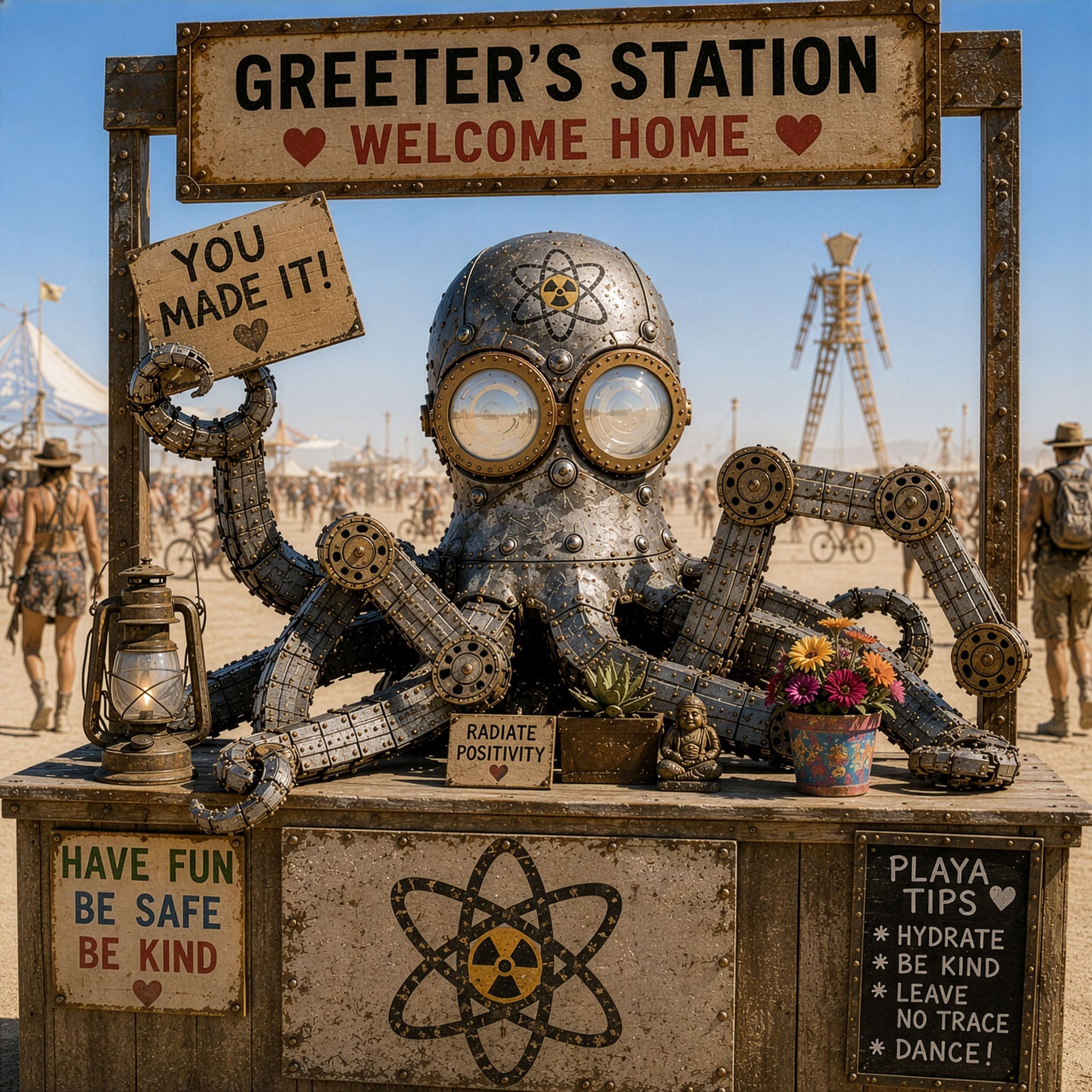
Atomic Octopus has always enjoyed what might be called the best of both worlds. Campmates generally handle their own breakfasts, lunches, snacks, and many dinners. Then everyone gathers once or twice during the week for a shared meal. One evening might feature Taco Tuesday. Another could become spaghetti night. Those meals become opportunities to reconnect, tell stories, and welcome new neighbors into camp.
Good communication makes this approach successful. Talk with your campmates before anyone begins shopping. Ask about food allergies, dietary restrictions, volunteer schedules, and other commitments that might affect attendance. Those conversations reduce waste, save money, and help everyone enjoy the meal together.
Choose the Style That Fits Your Adventure
There is no single “correct” way to build a camp kitchen.
After years of experimenting with different systems, Atomic Octopus has noticed that most burners naturally settle into one of three styles.
The Minimalist
Shelf-stable foods form the foundation of this approach. Canned meals, dehydrated foods, instant noodles, and other pantry-friendly items require little cooler space and very little ice. Cleanup is quick, preparation is simple, and the overall cost stays relatively low.
Minimalist does not mean inadequate. With thoughtful planning, it can become one of the most efficient food systems on the playa.
The Balanced Approach
Many experienced burners eventually arrive here. Fresh ingredients fill the cooler during the first part of the week. Frozen meals gradually thaw into later dinners. Shelf-stable foods become increasingly important as the event continues. Around Atomic Octopus, this strategy earned a nickname. Cooler Jenga.
Every meal creates room for the next one. Fresh ingredients disappear before they spoil. Frozen meals become tomorrow’s dinner. Shelf-stable foods patiently wait their turn without competing for valuable refrigeration space. It takes a little planning. The reward is a cooler that works with you instead of against you.
Going Big
Some burners simply love to cook. Others operate permitted food gifting that serve the wider community. Larger kitchens often include multiple coolers, dedicated beverage coolers, dry ice, expanded cooking equipment, and considerably more preparation.
That approach can produce wonderful meals. It also requires more planning, more organization, and more cleanup. Fortunately, every one of these systems can succeed. The important question is not which approach is “best.” The important question is which approach supports your Burn, fits your budget, and allows you to spend less time worrying about food and more time experiencing everything Black Rock City has to offer.
Your Burning Man Food Planning Guide Starts With Cooler Space
One of the most valuable lessons in this Burning Man Food Planning Guide has nothing to do with cooking. It has everything to do with thinking differently about your cooler. Ask experienced burners what resources become valuable during the week, and you will hear plenty of good answers. Water is essential. Shade is priceless. Time always seems to disappear faster than expected. Another resource quietly influences almost every meal you will eat. Cooler space.
Every square inch inside your cooler has value. No matter how carefully you plan, it always seems there is one more thing you would like to pack than there is room to carry. That challenge affects first-time burners and dusty veterans alike. Fortunately, the solution is rarely buying a larger cooler. Instead, begin treating cooler space like a limited resource that deserves thoughtful planning. Every item should earn its place. If something can safely remain outside the cooler until it is opened, you have just created room for food that genuinely needs refrigeration.

That simple shift in thinking changes everything. Shopping becomes easier. Packing becomes more organized. Ice lasts longer. Meals become simpler. Most importantly, your camp kitchen becomes less stressful throughout the week.
Choose a Cooler That Matches Your Adventure
Many people preparing for their first Burning Man immediately begin comparing expensive coolers. That is understandable. It is also a little misleading. A successful camp kitchen depends far more on planning than on price.
If you decide to purchase a new cooler, pay attention to insulation rather than marketing. Many modern coolers advertise features such as “5-Day,” “7-Day,” or “Max” ice retention. Although real-world performance depends on weather, packing, and how often the lid is opened, insulation technology has improved significantly over the last several years. Fortunately, you do not need the most expensive cooler available.
Burning Man has always celebrated creativity, resourcefulness, and solving problems in ways that fit your own budget. A thoughtfully packed cooler that stays organized, remains in the shade, and stays closed whenever possible will often outperform a poorly managed cooler that costs several times as much. Thoughtful preparation almost always beats expensive gear.
There is one exception worth mentioning. Avoid inexpensive styrofoam coolers whenever possible.
Besides providing relatively poor insulation, they crack easily during loading, unloading, and everyday camp life. Every tiny white bead that breaks loose becomes Matter Out Of Place (MOOP). Those pieces are difficult to collect and work directly against Burning Man’s Leave No Trace principles. A sturdy cooler is not about luxury. It is about durability, organization, and reducing unnecessary waste.
Heat Comes From More Than the Sun
Most burners know to keep their cooler in the shade. Far fewer think about what is happening underneath it. By afternoon, the Black Rock Desert has absorbed hours of intense sunshine. The playa begins radiating that heat back upward like a giant pizza stone fresh from the oven. Even if your cooler never leaves the shade, it is still absorbing heat from below.
Fortunately, solving that problem is surprisingly easy. Raise your cooler off the ground. A sturdy table, a simple wooden platform, or any stable raised surface creates an insulating air gap between the cooler and the hot playa. At Atomic Octopus, campmates built uncomplicated wooden tables specifically for this purpose. Coolers rest on top while clearly labeled storage bins slide neatly underneath.

That single improvement accomplishes several goals. Ice lasts longer. The kitchen becomes easier to organize. Dry goods remain easy to reach. Another work surface becomes available around camp. Best of all, the solution costs very little. Like so many successful Burning Man ideas, it is not about buying something fancy. It is about understanding the problem and solving it creatively.
Shelf-Stable Foods Belong in Every Burning Man Food Planning Guide
Once you begin thinking about cooler space differently, another pattern quickly becomes obvious. Some foods work much harder than others. Shelf-stable foods deserve a place in almost every Burning Man Food Planning Guide because they patiently wait their turn without occupying valuable refrigeration space.
When building your shopping list, ask yourself a simple question. Does this item actually need to be refrigerated before it is opened? Many excellent foods do not. Peanut butter, canned chicken, canned tuna, Spam, sardines, smoked oysters, olives, pickles, trail mix, mixed nuts, dried fruit, oatmeal, pasta, rice, crackers, shelf-stable soups, and instant noodles can all become valuable members of your camp pantry. Several of those foods only require refrigeration after they have been opened. Until then, they quietly wait in a storage bin instead of competing for room inside the cooler.
That strategy creates flexibility throughout the week. Fresh ingredients receive the cold storage they need. Shelf-stable foods patiently wait their turn. Your cooler becomes noticeably less crowded. If cooler space is hidden currency, shelf-stable foods are one of the smartest investments you can make.
Our companion Burning Man Meal Planning Guide explores practical ways to build delicious breakfasts, lunches, dinners, and snacks around many of these ingredients while keeping preparation simple and efficient.
Organize Your Cooler Before You Need It
Every experienced burner has opened a cooler looking for one specific ingredient. Perhaps it is the cheese for dinner. Maybe it is tomorrow’s breakfast sausage. Sometimes it is nothing more than a bottle of mustard hiding beneath the ice. Five minutes later, both hands are freezing, half the cooler has been rearranged, and whatever you were searching for finally appears at the bottom. Pani and Trilo know that experience well. For years they joked about “plunging into the mighty ice” every time dinner required one small ingredient.
Eventually, they stopped searching randomly and started organizing intentionally. Large reusable freezer bags became simple compartments inside the cooler. One held meats. Another stored cheese. Condiments lived together. Breakfast ingredients stayed in their own section. Extra large bags are hard to find in stores, but XL bags from a few brands can be found easily online.
Finding dinner suddenly took seconds instead of minutes. That improvement offered another unexpected benefit. The cooler stayed open for much less time. Cold air remained inside. Warm desert air stayed outside. Ice melted more slowly. Good organization also extends beyond the cooler itself.
Clearly labeled storage bins keep dry goods, cookware, spices, snacks, and utensils easy to locate. Readers interested in building an efficient camp pantry should also explore our Storage Bins for Burning Man guide, which explains how thoughtful organization before departure can simplify every day on the playa. A well-organized kitchen may never become your favorite memory of Burning Man. However, it quietly creates more opportunities for the moments that will.
Build a Better Burning Man Food Planning Guide One Meal at a Time
Once your cooler is organized and your shopping list is taking shape, it is time to think about the meals themselves. Many first-time burners imagine preparing dinners much the same way they do at home. Then Burning Man happens.
You spend the afternoon exploring art installations. A conversation with a stranger turns into an hour-long adventure. Dust rolls across the playa just as you decide it is time to head back to camp. Before long, the sun has set and dinner has not even crossed your mind. That is perfectly normal. Black Rock City has a remarkable ability to rearrange your schedule.
A successful Burning Man Food Planning Guide does not fight that reality. Instead, it embraces flexibility. Your meals should support your adventure instead of competing with it.
A Great Playa Meal Solves More Than One Problem
The best meals at Burning Man do more than satisfy your appetite. They save time, reduce cleanup, protect valuable cooler space and help maintain your energy throughout the day. Whenever possible, choose meals that accomplish several of those goals at once.
A frozen dinner prepared at home is a perfect example. During the first part of the week, it helps keep the cooler cold. Later, it becomes a quick meal that requires very little preparation. Finally, cleanup takes only a few minutes, allowing you to head back out into Black Rock City instead of spending the evening washing dishes. Meals that perform multiple jobs almost always become favorites.
Simplicity Is One of the Best Ingredients
After years of camping on the playa, Atomic Octopus noticed something interesting. The more complicated a dinner became, the less excited anyone felt about making it. That should not come as a surprise. Complex recipes usually require more ingredients, more cookware, more preparation, and considerably more cleanup. Every additional step keeps you in camp while remarkable things are happening elsewhere in the city.
Simple meals often become the better choice. That does not mean boring. It is about being efficient. As a general rule, Atomic Octopus tries to build meals that can go from cooler to plate in about ten minutes whenever practical. Those extra minutes quickly add up over the course of a week.
An efficient dinner on six evenings can easily create several additional hours for exploring art, visiting neighboring camps, watching a sunrise, or simply relaxing with friends. That is a remarkable return on a little planning. Readers looking for practical meal ideas should also explore our companion Burning Man Meal Planning Guide, where we take a much deeper look at breakfasts, lunches, dinners, snacks, and some of our favorite playa recipes.
Your Burning Man Food Planning Guide Should Match Your Burn
Every burner experiences Burning Man a little differently. Some participants volunteer every day. Others spend hours riding bicycles across the open playa. Many enjoy dancing late into the night. Some camps build large projects before the event even begins. All of those activities require energy.
While this guide is not intended to offer nutritional advice, it is worth remembering that Burning Man places unusual demands on your body. Walking, cycling, lifting equipment, dancing, and simply spending long days outdoors require calories. Do not underestimate how much energy you may use during the week.
Whether you are an omnivore, vegetarian, vegan, or follow another dietary approach, plan meals that leave you feeling energized rather than depleted. Your body is one of the most important pieces of equipment you bring to Burning Man. Fuel it accordingly.
Smaller Meals Often Work Better
Many people assume they will want enormous dinners after an active day in the desert. Sometimes that happens. Quite often, it does not. Heat, dust, excitement, and constant activity affect everyone’s appetite differently. Some evenings call for a hearty meal. Others are better suited to something lighter before heading back out to explore.
Planning several smaller meals instead of a few oversized ones offers several advantages. Portions become easier to finish. Food waste decreases. Cleanup becomes simpler. Leftovers become less common. If you are still hungry, preparing another small serving usually takes only a few minutes. Flexibility almost always wins.
Salty Foods Can Become Unexpected Favorites
Many burners discover something amusing during their first week in Black Rock City. Foods they rarely think about at home suddenly taste wonderful. Pickles. Olives. Salted nuts. Smoked seafood. Jerky. There is a practical reason for that.
Your body loses water and electrolytes throughout the day, especially during hot weather and periods of sustained activity. Salty foods can become both satisfying and convenient because many remain shelf-stable until they are opened. They also require very little preparation. If you would like to learn more about staying hydrated and maintaining healthy electrolyte levels, be sure to read our companion guide, Hydration at Burning Man, where we explore that topic in much greater detail.
Bring Something That Makes You Smile
Nutrition is important. Efficiency matters. Saving cooler space deserves attention. Do not overlook morale.
Pack at least one food that simply makes you happy. Perhaps it is your favorite chocolate. Maybe it is a special coffee that reminds you of home. It could be the world’s greatest beef jerky from a local shop or a family recipe that always appears on camping trips. Those foods provide more than comfort. They often become conversation starters.
Offer a favorite snack to a campmate and explain why it is meaningful to you. Chances are good they will respond with a story of their own. Before long, everyone around the table has learned something new about each other. Burning Man has always been about building community. Sometimes that begins with nothing more complicated than sharing a favorite snack and a good story.
A Great Burning Man Food Planning Guide Adapts to the Unexpected
One thing is almost guaranteed at Burning Man. Something will not go according to plan. Perhaps you stay out later than expected because an art installation completely captures your imagination. A volunteer shift may run longer than anticipated. Friends might invite you to watch the sunrise after an unforgettable night of dancing. Dust storms have a habit of changing everyone’s schedule.
Fortunately, none of those situations need to become a problem if your food plan is flexible. The best Burning Man Food Planning Guide is not built around a rigid timetable. Instead, it gives you options. If dinner happens at six o’clock one evening and nine-thirty the next, your kitchen should be ready for either scenario. Flexibility is one of the greatest ingredients you can pack.
Prepare More at Home and Cook Less on the Playa
One of the easiest ways to improve your week begins before you ever leave home. Complete as much food preparation as possible in your own kitchen. Your home has better lighting, more counter space, larger sinks, and every tool within easy reach. Taking advantage of those conveniences before departure means less work after arriving in Black Rock City. Many meals can be fully cooked at home, divided into individual portions, frozen, and packed before the trip. Others can be partially prepared so they only require a few minutes of heating before they are ready to serve.
This approach offers several advantages. Preparation becomes easier. Cleanup becomes faster. Cooking requires less attention. Frozen meals also help keep the rest of the cooler cold during the first part of the week. As they slowly thaw, they become tomorrow’s dinner instead of simply occupying valuable cooler space.
Readers looking for meals that freeze well should also visit our companion Burning Man Meal Planning Guide, where we share many of our favorite make-ahead ideas.
Vacuum Sealing Is a Useful Tool, Not a Requirement
Many experienced burners appreciate the convenience of vacuum-sealed meals. Removing excess air helps protect food in the freezer, reduces the chance of leaks inside the cooler, and makes meals easier to organize. Vacuum-sealed packages also stack neatly, allowing you to use cooler space more efficiently.


That does not mean everyone needs to buy a vacuum sealer. Perhaps someone in your camp already owns one. Maybe a friend is willing to help prepare meals before departure. Burning Man has always encouraged people to share resources, borrow equipment, and solve problems creatively. A vacuum sealer can certainly make preparation easier, but thoughtful planning remains far more important than owning another piece of equipment.
Shopping Early Saves More Than Money
Many burners wait until the final week before departure to buy everything on their list. That approach usually creates crowded stores, rushed decisions, and an expensive shopping cart. A better strategy is spreading purchases over several weeks or even a few months. Shelf-stable foods, canned goods, beverages, snacks, spices, and many cooking supplies store well at home until it is time to pack. Purchasing those items whenever they go on sale reduces the overall cost of preparing for Burning Man.
Shopping early offers another important benefit. It gives you time to think. As your food plan develops, you may discover duplicate items, missing ingredients, or opportunities to simplify a meal before everything is packed into the vehicle. Preparation rarely feels exciting. Its rewards become obvious once you arrive on the playa.
Keep a Few Backup Meals
Even the best meal plans occasionally fall apart. Fortunately, solving that problem is easy. Pack several meals that require almost no effort. Shelf-stable soups, canned meals, instant noodles, protein bars, trail mix, and similar foods provide reliable backup options when your original plans change unexpectedly.
Those meals may never become your favorites. That is perfectly fine. Their job is providing peace of mind. Canned goods can be donated on the road heading home from Black Rock City. Most leftovers can return home with you or become part of your camping supplies for future adventures, so very little goes to waste.
Radical Self-Reliance Includes Your Camp Kitchen
Thoughtful food planning is one of the simplest ways to practice Radical Self-Reliance. Bring enough food to care for yourself throughout the week. Pack enough water to remain healthy. Prepare for unexpected delays.
Those simple steps remove an enormous amount of uncertainty from your adventure. They also allow you to enjoy one of Burning Man’s most generous traditions. Food gifting. Black Rock City is filled with camps that happily share pancakes, grilled cheese sandwiches, fresh coffee, desserts, and countless other treats with visitors. Those meals are wonderful. They are also gifts.
Build your personal food plan so those unexpected moments remain delightful surprises instead of necessary sources of nutrition. Atomic Octopus has proudly participated in public food gifting over the years, and there is something worth remembering.
Volunteers prepare those meals because they enjoy creating memorable experiences for the community. They are not operating restaurants. Arriving well prepared is one of the best ways to honor the time, effort, and generosity those volunteers contribute throughout the week.
Food Brings People Together
A thoughtful Burning Man Food Planning Guide is about much more than calories. Meals create opportunities to slow down. Coffee encourages conversations before the city fully wakes up. Dinner becomes a chance to reconnect after a day filled with different adventures. Favorite snacks often lead to stories about home, family traditions, memorable road trips, or childhood vacations. Those conversations strengthen friendships.
They also remind us that sharing food has always been about more than simply eating. It is one of humanity’s oldest ways of building community. That spirit feels especially at home in Black Rock City, where complete strangers often become lifelong friends after spending a few minutes talking beneath a shade structure. One simple meal may never become the most memorable part of your Burn. The conversation around that meal just might.
Reduce Waste With a Better Burning Man Food Planning Guide
One of the biggest advantages of thoughtful food planning is that it naturally reduces waste. Everything in your cooler costs money. Every trip to buy ice takes time. Anything that spoils represents space that could have been used more effectively. Fortunately, avoiding waste is much easier than many people expect.
Begin by planning meals in the order you expect to eat them. Fresh ingredients usually belong at the beginning of the week. Frozen meals gradually become later dinners. Shelf-stable foods patiently wait until they are needed. That simple approach creates a natural progression throughout the event. Nothing has to compete for cooler space longer than necessary. Food is less likely to spoil. Ice lasts longer. Your camp kitchen becomes easier to manage every day.

Another useful habit is looking for ingredients that can appear in more than one meal. A package of cheese might become part of breakfast one morning and dinner the next evening. Salsa can brighten scrambled eggs, tacos, or grilled meat. Small decisions like these reduce leftovers while making shopping much simpler.
Readers looking for meal combinations that reuse ingredients efficiently should also explore our companion Burning Man Meal Planning Guide, where we discuss practical menu planning in much greater detail.
Every Burning Man Food Planning Guide Gets Better With Experience
No burner builds the perfect food plan the first time. In fact, experienced burners continue refining their systems year after year. One meal may become a favorite. Another recipe might require more effort than it was worth. Perhaps you packed too much food. Maybe you wished you had brought another shelf-stable backup meal.
Every Burn teaches something new. Before unpacking at home, spend a few minutes making notes while the memories are still fresh. Write down the meals everyone enjoyed. Record foods that never left the storage bin. Notice which snacks disappeared during the first few days. Those observations become invaluable when planning next year’s adventure.
Many experienced campers keep a simple notebook or digital document dedicated to Burning Man preparation. Over several years, it becomes one of the most useful planning tools they own. Experience is difficult to purchase. Fortunately, it is easy to record.
Leave No Trace Starts in Your Camp Kitchen
One of Burning Man’s most important principles applies just as much to food as it does to every other part of camp life. Leave No Trace begins before you leave home. Removing unnecessary packaging during packing reduces the amount of trash you generate on the playa. Reusable containers often protect food better while creating less waste throughout the week. Thoughtful organization also helps prevent accidental MOOP. Close food containers when they are no longer needed. Store lightweight wrappers where the wind cannot carry them away.
Take a quick look around your kitchen before leaving camp each morning. Those small habits become second nature surprisingly quickly. They also help protect the Black Rock Desert for everyone who will visit in the future. Our Leave No Trace guide explores this topic in much greater depth, including practical tips for reducing MOOP throughout your camp.
Your Kitchen Should Support Your Adventure
After thousands of words discussing food, coolers, shopping, preparation, and organization, one simple idea rises above everything else. Your kitchen exists to support your Burn. It is not the destination. It is one of the tools that helps you experience the destination.
A thoughtfully prepared breakfast creates energy for a long day of exploring. An organized cooler saves valuable time every evening. A simple dinner means more opportunities to accept an unexpected invitation from new friends. None of those moments happen because your food plan was complicated. They happen because it was simple enough that you stopped thinking about it. That is one of the highest compliments any camp kitchen can receive.
When your meals quietly take care of themselves, your attention naturally shifts toward the art, music, community, generosity, and creativity that brought you to Black Rock City in the first place.
Final Thoughts on Your Burning Man Food Planning Guide
There is no perfect menu for Burning Man. No universal shopping list exists. Camps develop their own traditions. Every burner discovers favorite meals. Each year teaches new lessons. That is part of the adventure. The goal of this Burning Man Food Planning Guide has never been to tell you exactly what to eat. Instead, it has been about helping you build a food system that fits your budget, your camp, your cooking style, and the experience you hope to create.
Thoughtful preparation reduces stress. Simple meals create flexibility. Good organization saves time. Shelf-stable foods protect valuable cooler space. Shared meals build friendships. Those ideas work together to accomplish something much more important than feeding your body.

They create opportunities. Opportunities to explore one more neighborhood, volunteer for another project or accept a spontaneous invitation. Instead of worrying about dinner. Years from now, you probably will not remember exactly what you ate on Tuesday afternoon. There is a very good chance you will remember the conversation that happened while breakfast was cooking. You may remember laughing with campmates while sharing your favorite snacks from home. Perhaps you will think back to the sunrise you watched because dinner only took ten minutes to prepare.
Those are the moments worth planning for. Prepare thoughtfully. Pack wisely. Share generously. Then spend as little time as possible thinking about food and as much time as possible experiencing the remarkable city waiting beyond your shade structure. Do not simply survive. Thrive.
Burning Man Underwear Guide: What to Wear (Or Not Wear) on the Playa

The Art Of Participation
Burning Man First Aid Kit Guide: Smart Playa Prep for Camp

Getting to Burning Man: There and Back Again

Burning Man Tent Tips: Sleep Better on the Playa

Leave No Trace: The Ultimate Guide to MOOP at Burning Man


