
Every summer, a familiar mantra begins echoing through garages, living rooms, storage units and Burner group chats: Pack All The Things! It sounds funny until Burning Man packing actually begins. Then it starts sounding less like a joke and more like an operating philosophy.

For many first-time Burners, Burning Man involves packing more gear into a vehicle than they have ever attempted before. Experienced participants are not necessarily immune. Add shade equipment, bikes, food, water, clothing, bedding, tools, camping gear and assorted playa necessities, and even a large vehicle can suddenly look suspiciously small.
The challenge is not simply making everything fit. You need to organize your gear so people can unload it efficiently. You need to distribute weight safely. Some things need to remain accessible during the drive. Other things need protection from shifting loads, dust and highway wind. Most importantly, packing and loading will probably take longer than you think.
This Burning Man Packing Guide is not another enormous list of everything you should bring to Burning Man. There are plenty of lists available, and by this point you have hopefully made most of those decisions. Our other Burning Man Pro Tips guides cover subjects including what to wear, meal planning, first aid supplies, bikes, storage bins, generators and fuel, footwear and plenty more.
This guide tackles the next problem. You have All The Things. Now how do you get them to Black Rock City?
Start Your Burning Man Packing With Organization
Organization starts before the first storage bin goes into the vehicle. Most Burning Man gear falls into two broad categories: personal stuff and camp stuff. Personal gear includes clothing, toiletries, bedding and other things destined for your tent, yurt or other sleeping space. Camp gear includes tools, kitchen supplies, food, infrastructure and equipment destined for shared areas.
Keep those categories separate whenever possible. Why? Because you may not be the person unloading your vehicle.
Perhaps several campmates will rush over to help empty a hot vehicle when you arrive. Maybe your gear traveled in a shared rental truck with equipment belonging to several people. Either way, somebody should be able to pick up a container, read the label and immediately know where it belongs.
Put your name on everything. Then add a destination. PERSONAL tells everyone that a bin goes to your camping space. KITCHEN tells them where the food and cooking equipment belong. TOOLS sends another container toward the build supplies. Use whatever terminology your camp actually uses for its common areas. Good labels transform unloading from archaeology into logistics.
Label and Secure Your Burning Man Storage Bins
If you followed our Burning Man Storage Bins Guide, you probably already chose containers and figured out what goes inside them. Now make sure they are ready for the journey. Close every bin securely.

Atomic Octopus recommends using zip ties or another appropriate method to keep containers from accidentally opening during transportation and unloading. Gear shifts. Bins tip. Vehicles hit potholes. Then, because the playa has impeccable comic timing, a dust storm can arrive five minutes after you unload everything.
A securely closed bin prevents its contents from scattering across the vehicle or Black Rock City. It also means you do not have to chase underwear down the street while introducing yourself to your new neighbors. Save the Radical Self-Expression for later.

Keep Your Arrival Gear Within Reach
Some Burning Man supplies should not disappear beneath three feet of meticulously packed camping equipment. Keep your goggles, dust mask, work gloves and headlamp somewhere accessible inside the vehicle.
You may plan to arrive at noon under beautiful blue skies. That does not mean you will. Traffic delays happen. Gate lines happen. Mechanical problems happen. Your daytime arrival can become a nighttime arrival surprisingly quickly. Likewise, dusty or windy conditions can greet you at Gate, Greeters or camp. Your goggles will not help much if they are buried inside a carefully labeled bin underneath your bicycle.
Keep plenty of drinking water and shelf-stable snacks accessible during the drive as well. You may spend hours slowly moving through traffic before reaching camp. Hydration and food should never depend on getting into the back of a completely packed vehicle. This is an important part of Burning Man packing because accessibility matters almost as much as making everything fit.
Tickets and Passes Are Part of Burning Man Packing
Before you leave, check the documents. Then check them again. Make sure you have everything required for your arrival, including your Burning Man ticket (or a printout of the information for will call pickup) and vehicle pass. Each participant arriving before the public Gate opens may also require a valid Setup Access Pass for their scheduled arrival date. Burning Man establishes specific rules governing early arrivals, so consult the current official information before departure.
For Burning Man packing purposes, however, the lesson is simple: Make sure every person in the vehicle has everything required for entry. Do not discover hundreds of miles from home that an essential document is sitting on the kitchen counter. That is one item you cannot replace with duct tape.
Burning Man Packing: Heavy, Light and Weird
Once everything is organized, Atomic Octopus uses an extremely sophisticated classification system developed through decades of camping experience. There are three categories: Heavy. Light. Weird.
Heavy things are obvious. Full storage bins, equipment and other dense gear belong in this category. Light gear includes lighter containers and equipment that can safely sit above heavier items. Then there is Weird. Weird stuff refuses to participate in the tidy geometric fantasy created by your storage bins. Camp chairs are weird. Sleeping bags are weird. Pillows are weird. A landscaping rake for the final MOOP sweep is definitely weird. You can probably guess what category a 30-foot Atomic Octopus falls into.
Weird gear is often lightweight, but it does not stack efficiently. Do not fight the Weird. We will find a home for it later.
Put Heavy Gear Low and Forward
During Burning Man packing, your goal should never be simply to cram things into every available cubic inch. The load also needs to be safe. Start with the heaviest items on the bottom. Lighter containers belong above them. Otherwise, heavy gear can crush lighter equipment. More importantly, placing too much weight high in the vehicle can affect its center of gravity and handling.
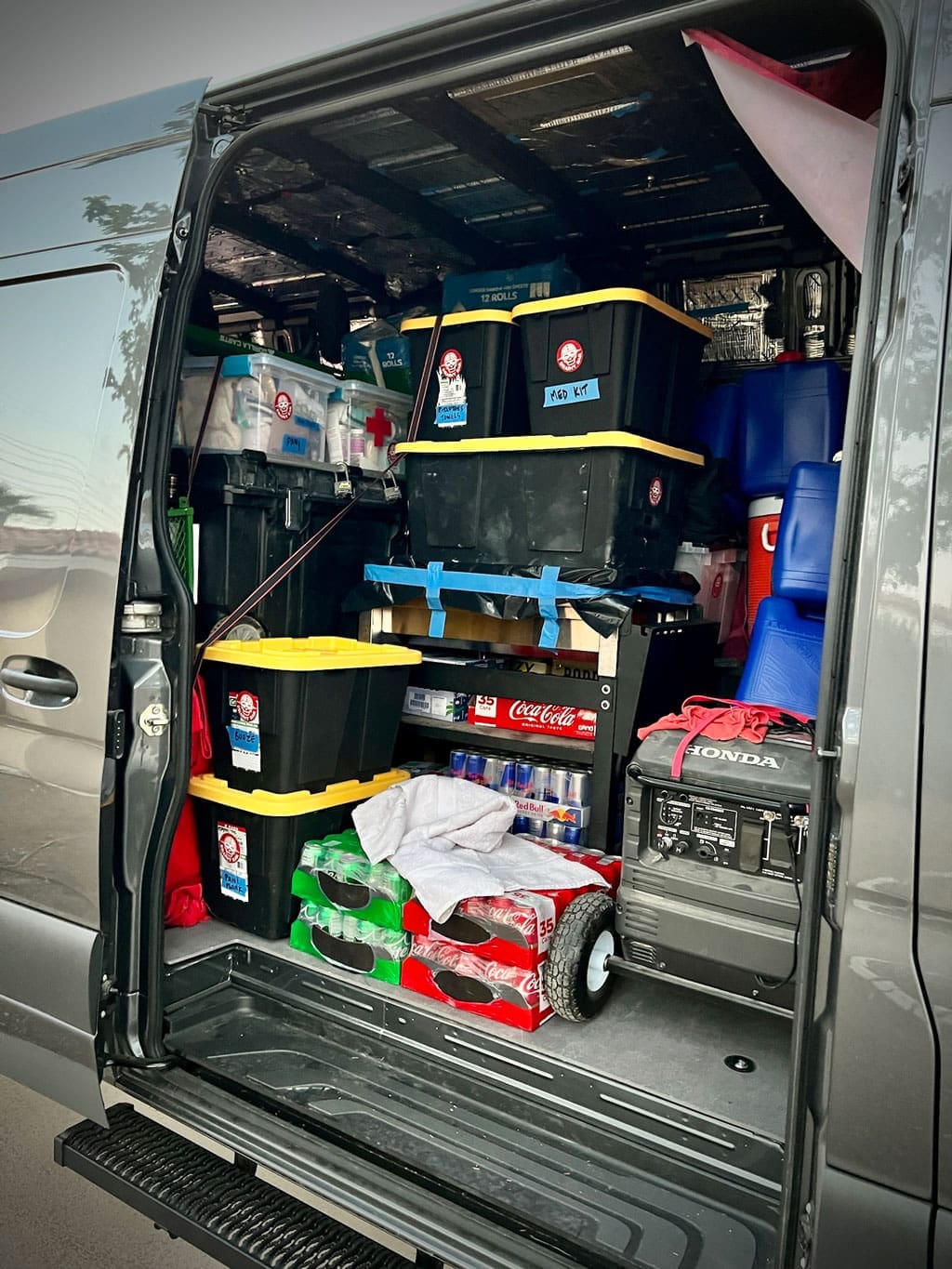
Think about weight distribution from front to back as well. In a truck, van or similar vehicle, keep heavier cargo forward whenever practical rather than concentrating a large amount of weight at the very back.
Then think about the vehicle from left to right. You want balance. If you load several extremely heavy containers along the left side while filling the right side with pillows and sleeping bags, the vehicle may become noticeably unbalanced.
Instead, distribute heavy items across both sides. After loading something particularly heavy on the left, look for an appropriate heavy item for the right. You are not trying to achieve laboratory precision. You are trying to avoid creating a dramatically lopsided vehicle before driving hundreds of highway miles.
Know Your Vehicle’s Limits
Making everything physically fit does not necessarily mean the vehicle can safely carry it. Vehicles have payload limits. Trailers have weight ratings. Hitches have limits. Roof racks have limits. Before loading an extraordinary amount of gear, check the specifications for your particular vehicle and equipment. Remember that passengers, cargo and other weight all count.
Burning Man inspires impressive feats of packing Tetris. Physics remains unimpressed. That is especially important because Burning Man packing often pushes vehicles much closer to their carrying capacity than an ordinary road trip.
Secure the Load Before Adding the Weird Stuff
Once the heavy gear is positioned, start adding the lighter equipment. Atomic Octopus generally loads lighter gear until the cargo reaches somewhere around two-thirds to three-quarters of the interior height of the van or truck.
Then come the ratchet straps. Secure the main load inside the vehicle before filling the remaining space. This can seem unnecessary. After all, the gear is inside an enclosed vehicle. Where could it go? Forward. Very quickly. A sudden stop can turn unsecured equipment into moving cargo. Ratchet straps and tie-downs help keep the load where you put it.

Once the primary load is secured, bring on the Weird. Pillows, camp chairs, sleeping bags and other lightweight irregular objects can fill spaces around and above the main load. They are excellent candidates for nooks and crannies that cannot accommodate another storage bin. This is where Weird becomes wonderful.
Burning Man Packing Means Leaving Some Things Accessible
There is an enormous temptation to celebrate when you discover one final empty space and immediately stuff something into it. Resist. Some empty spaces are intentional.
If you are traveling with coolers, for example, you may need access to them during the journey. Depending on your route and travel time, you might need to drain meltwater or add more ice. That becomes considerably more difficult when accessing the cooler requires unloading half the vehicle at a gas station. The same principle applies to anything you plan to purchase along the way. If you intend to pick up water later, leave room for the water.
That sounds painfully obvious. It becomes considerably less obvious at midnight when you are triumphant because you managed to fit one more storage bin into the only remaining water-sized space. Think about your route before loading. Anything you need to use, service or add along the way should influence where everything else goes.
Protect Your Gear Before Departure
A fully loaded Burning Man vehicle attracts attention. Unfortunately, not all of that attention comes from excited Burners who admire your bicycle decorations. Atomic Octopus has known too many people who spent enormous amounts of time and money preparing for Burning Man only to experience vehicle theft or break-ins shortly before departure.
Consider when and where you load. If vehicle theft or break-ins are a concern where you live, leaving an obviously Burning-Man-bound vehicle sitting fully loaded overnight may create unnecessary risk. When possible, get a good night’s sleep first. Then load and leave.
If you need to stop for last-minute supplies, be conscious of the loaded vehicle sitting in the parking lot. When traveling with another person, one person can stay with the vehicle while the other shops. It is a small precaution protecting a very large investment of time, money and effort.
Remember Your Bikes During Burning Man Packing
Bicycles create their own packing challenges, which we cover more thoroughly in our Burning Man Bike Guide. One small preparation step is worth mentioning here. Consider reducing tire pressure somewhat before transportation, particularly if you are traveling from significantly lower elevation or cooler conditions.
At Trilo’s first Burn in 2004, a couple of campmates arrived from near sea level. Within about 30 minutes of unloading, tires on two bicycles failed. That was not exactly the soundtrack anyone wanted for camp setup. Check your tires again after arrival and inflate them appropriately before riding.
Also think about where your bikes will ride during the journey. If they are mounted outside the vehicle, make sure racks and attachment points are secure before departure.
Packing Gas Cans for Burning Man
If you are transporting fuel for a generator, stop here and read our Burning Man Generator Guide along with Burning Man’s current fuel storage and transportation requirements. Fuel safety deserves more attention than a few paragraphs in a Burning Man Packing Guide.
From a loading perspective, however, plan for fuel before filling every inch of the vehicle. Atomic Octopus recommends traveling with empty fuel cans for most of the journey when practical, then purchasing fuel closer to Burning Man. That means you need to reserve an appropriate space for the fuel containers.

Plan for the required secondary containment. Give it a flat, stable location and make sure you have appropriate straps or tie-downs available to secure everything after fueling. Do not bury the fuel storage location behind equipment you will have to completely unload at the gas station.
Likewise, do not wait until the final possible opportunity to buy fuel. Stations closer to Black Rock City can become extremely busy during peak travel periods. Buying fuel earlier along the route can save considerable time. The goal is simple: arrive with fuel safely contained, securely transported and ready to be stored correctly at camp.
Burning Man Packing Tips for Trailers
Trailers require even more attention to weight distribution. Follow the same basic philosophy: Heavy. Light. Weird.
Keep heavy items low. Balance the load from left to right. Most importantly, pay careful attention to the trailer manufacturer’s loading instructions and proper tongue weight. Too much weight toward the rear can contribute to dangerous trailer sway.
Do not guess about safe trailer loading. Check the specifications for your trailer, tow vehicle and hitch, particularly if you are new to towing. Whenever possible, Atomic Octopus prefers putting pillows, bedding and other soft gear inside the tow vehicle rather than on an open trailer. Those objects are lightweight, but they can be awkward to secure. If something shifts or works loose during the drive, you could lose it on the highway. Just say no to highway MOOP. That is Leave No Trace starting hundreds of miles before you reach the playa.
Everything on an Open Trailer Gets Secured
An enclosed trailer gives you walls. An open trailer gives you consequences. Every single item needs to be secured.
That includes the Weird stuff you squeezed between two storage bins because it appeared physically incapable of going anywhere. Highway wind is remarkably talented at finding flaws in that theory. Use plenty of quality ratchet straps and tie-downs. Remove slack and make sure every part of the load is stable.

Pay particular attention to bicycles. Atomic Octopus has not personally experienced a bicycle theft during a roadside stop, but enough friends and campmates have that we take the possibility seriously. Lock bikes and trikes to the trailer or appropriate rack whenever possible.
And here is the gloriously mundane detail that can save you a headache: Make sure the driver has the key or combination. A bicycle secured with an indestructible lock becomes significantly less impressive when the key is 500 miles away.
Ratchet Straps Are Burning Man Packing Essentials
If you are transporting gear in a truck, van, trailer or roof rack, bring plenty of ratchet straps and appropriate tie-downs. Then bring a few more. Inspect them before departure. Look for damaged webbing, questionable hardware or anything else that makes you reluctant to trust a strap with your equipment at highway speeds.
Once everything is loaded, tighten the straps properly and check the entire load. For an open trailer, be particularly meticulous. Push things. Pull things. Give the load a good shake. If something moves significantly while you are standing still, imagine what it could do after hours of vibration, wind and highway travel. Remember that securing the load is not the final five-minute step of Burning Man packing. It is part of the loading process itself.
Get Another Person to Check Your Burning Man Packing
One of the easiest Burning Man packing tips costs nothing and takes only a few minutes. Ask somebody else to inspect the load. Ideally, that person has experience loading trucks or towing trailers. However, experience is not required for a second set of eyes to be useful.
Have them look at the weight distribution, pull on straps, check the bikes. Look for loose objects. Ask why you put that thing there. You have probably been staring at this pile for hours. At some point, your brain stops seeing individual objects and starts seeing one enormous beige blob labeled BURNING MAN.
Fresh eyes can spot something you missed.
Give Your Burning Man Packing More Time Than You Think
Perhaps the biggest lesson in this entire Burning Man Packing Guide has nothing to do with storage bins, trailers or ratchet straps. Give yourself time. Packing the bins takes time. Labeling takes time. Moving everything outside takes time.
Discovering that your brilliant loading plan does not actually fit takes time. Taking everything back out and trying again takes even more time. Then somebody remembers the shade cloth. Do not schedule your departure based on the assumption that you can throw everything into the vehicle in an hour.
If possible, stage your gear beforehand. Group personal equipment together. Put camp equipment together. Separate Heavy, Light and Weird. Make sure the things you need during the journey are clearly identified. Have your straps ready before loading rather than discovering halfway through the process that they are in the bottom of a storage bin.
Packing efficiently is not about moving faster. It is about eliminating unnecessary work.
Your Other Burning Man Guides Come Together Here
One reason Burning Man packing can feel overwhelming is that almost every other part of event preparation eventually ends up in the same place: your vehicle. The clothing you selected after reading our What to Wear at Burning Man Guide needs a home. The food from your Burning Man Meal Planning Guide needs to fit somewhere.
Your first aid supplies need to remain organized. Your footwear needs protection from getting crushed. Your storage bins have to stack. Your bike needs transportation. Generator supplies require careful planning, and your tent and camping equipment have to join the party too.
That is why this stage can feel so different from packing for an ordinary vacation. You are not packing a suitcase. You are transporting a temporary life.
Fortunately, all those earlier decisions can make the final process easier. Good storage bins stack. Thoughtfully planned clothing takes less room. Smart meal planning can reduce cooler space. Organized camp equipment makes loading and unloading faster. Preparation compounds. So does clutter.
Pack All The Things, Then Get Them There Safely
There is a wonderfully absurd moment in almost every Burning Man departure when you look at a completely packed vehicle and wonder how all of that stuff possibly fits inside.
You have clothing, food, water, shelter, tools, bicycles, coolers, camping equipment and enough oddly shaped objects to make a geometry teacher reconsider their career. Somehow, it fits. That is Burning Man packing. That is Pack All The Things. However, successful Burning Man packing is not measured by whether you managed to close the door.
Your gear should be organized so it can be unloaded efficiently. Heavy equipment should be low and appropriately distributed. The load should be secured. Important arrival supplies should remain accessible. Bikes and trailer cargo should be protected. You should leave space for anything you plan to acquire along the way. Most importantly, your vehicle and trailer need to remain within their safe operating limits.
All those other Burning Man Pro Tips guides helped you decide what to wear, what to eat, what to put in your first aid kit, how to prepare your bike, which storage bins to use and what equipment your camp might need. Now comes the moment when all those lists become physical objects sitting in front of you.
Take your time. Organize everything. Load it thoughtfully. Secure it properly. Check it twice. Then climb into that spectacularly overprepared adventure machine and head toward Black Rock City.
You did it.
You Packed All The Things.

Burning Man Meal Planning Guide: Easy, Delicious Meals for the Playa

Occo The Day: July 9

Chronocephalus

Billy Idol: Four Hours of Rebel Rock and Roll

Occo The Day: July 3

Dreams Of Fainting


